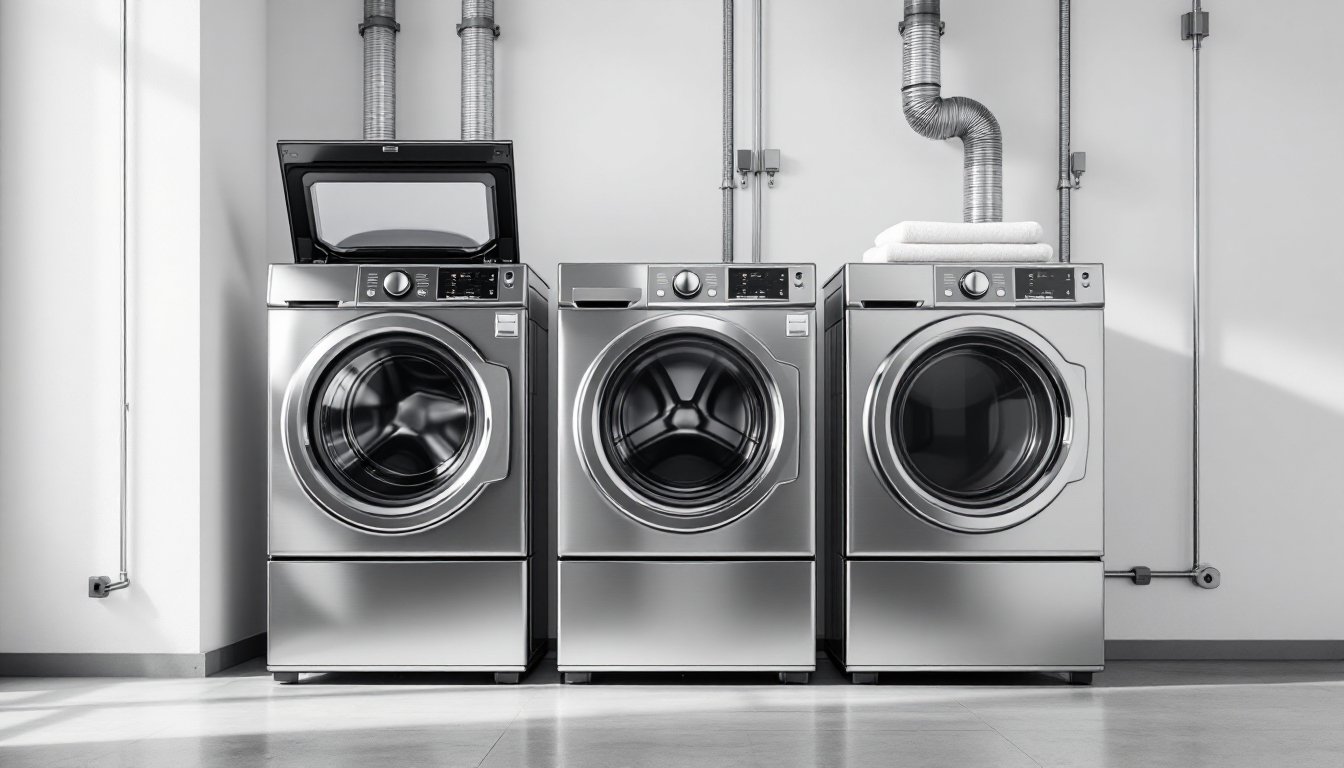
Commercial-grade laundry equipment isn’t just for laundromats anymore. More homeowners are installing heavy-duty washers and dryers built to handle continuous use, larger loads, and years of hard work without breaking down. These machines come with trade-offs, they’re louder, pricier, and sometimes require dedicated electrical and plumbing setups, but for large families, frequent launderers, or anyone tired of replacing consumer units every five years, they’re worth considering. This guide walks through what separates commercial machines from residential models, why they might make sense for your home, and what to know before you buy.
Table of Contents
ToggleKey Takeaways
- Commercial grade washers and dryers are designed for continuous heavy use and can last 15 to 25 years, making them ideal for large families and households doing multiple loads daily.
- These machines offer significantly larger capacities (3.5 to 4.5 cubic feet) and faster cycle times (25-40 minutes) compared to residential models, but require 240V electrical service, larger gas lines, and upgraded plumbing with higher flow rates.
- Commercial laundry equipment lacks consumer-friendly features like smart home connectivity and quiet operation, but makes up for it with durability, simpler controls, and straightforward repairs using readily available parts.
- Installation of commercial grade dryers requires rigid metal ductwork, dedicated circuits rated for 30-50 amps, and careful floor reinforcement since these units weigh 200-400 pounds empty.
- Homeowners should expect louder operation (over 70 decibels), higher water and energy consumption per load, and should hire licensed professionals for electrical, gas, and plumbing upgrades before setup.
What Makes a Washer and Dryer Commercial Grade?
Commercial-grade washers and dryers are designed for continuous operation in high-traffic environments like laundromats, hotels, and apartment buildings. Unlike residential models that cycle a few loads per week, commercial units can handle 10 to 30 loads per day without overheating or wearing out prematurely.
The main differences come down to build quality and component selection. Commercial machines use heavier-duty motors, steel frames, and reinforced drum bearings that resist the constant vibration and stress of back-to-back cycles. The suspension systems are built to manage off-balance loads without walking across the floor or shaking apart. Control panels are often simpler, coin-op or basic digital timers, because they need to survive rough handling and minimal maintenance.
Another distinction: venting and drainage. Commercial dryers typically require larger exhaust ducts (often 4 inches in diameter) and higher CFM (cubic feet per minute) airflow than home units. Washers may use direct-drain systems rather than relying on a household standpipe, meaning faster cycles but potentially more complex plumbing.
Commercial units also lack many consumer-friendly features like steam cycles, smartphone connectivity, or dozens of specialty settings. They’re built to do one thing extremely well: wash or dry heavy loads quickly and reliably. If you’re expecting smart home integration or whisper-quiet operation, you’re looking at the wrong category.
Why Homeowners Are Choosing Commercial Grade Laundry Equipment
The biggest driver is longevity. Residential washers and dryers typically last 8 to 12 years with average use. Commercial models, even in a home setting with lighter daily loads, can run 15 to 25 years or longer. For households doing multiple loads daily, think large families, home daycares, or anyone with athletic kids, that durability pays off.
Capacity is another major reason. While high-efficiency (HE) front-loaders dominate the residential market, many commercial top-loaders offer 3.5 to 4.5 cubic feet of usable drum space and can handle bulky items like comforters, sleeping bags, and multiple sets of sheets in one go. Commercial dryers often match or exceed this capacity, cutting down total cycle time.
Some homeowners also appreciate the no-nonsense operation. There’s no digital control board to fry, no proprietary app to update, and no over-engineered door latch that fails and bricks the machine. Repairs tend to be straightforward, and parts availability is strong because these machines are serviceable workhorses, not planned-obsolescence appliances.
That said, commercial units aren’t for everyone. They’re louder during spin cycles, often exceeding 70 decibels, and they consume more water and energy per load than modern HE models. If your laundry room shares a wall with a bedroom or you’re trying to minimize utility bills, residential high-efficiency units are a better fit. But if you value durability and performance over efficiency ratings, the commercial route makes sense.
Key Features to Look for in Commercial Grade Home Laundry Units
Durability and Build Quality
Look for stainless steel or porcelain-coated steel drums. Plastic tubs, common in budget residential models, crack under sustained use. The frame should be welded steel, not stamped sheet metal. Check the motor rating, commercial washers often use 1/2 HP to 3/4 HP motors compared to the 1/3 HP or less found in home units.
Bearing assemblies are critical. Sealed, greaseable bearings extend service life and reduce maintenance. Some commercial machines use direct-drive systems that eliminate belts altogether, cutting down on parts that wear out. If you’re buying used or refurbished, ask about bearing condition and whether the transmission has been rebuilt.
Control systems vary. Coin-op models can be converted for home use by bypassing the coin mechanism, but some buyers prefer programmable commercial controls that let you set custom cycle times, water levels, and spin speeds. Avoid units with complex electronic boards unless you’re confident in your ability to source and replace them.
Capacity and Performance Specifications
Washer capacity is measured in cubic feet, but pay attention to weight capacity as well. A 3.5-cubic-foot commercial top-loader might handle 22 to 24 pounds of laundry per cycle, compared to 18 pounds for a similar-sized residential model. That extra capacity comes from a more robust suspension and a higher-torque motor that can spin heavier, water-saturated loads.
For dryers, focus on BTU ratings (for gas models) or wattage (for electric). Commercial gas dryers often run 30,000 to 35,000 BTUs, compared to 20,000 BTUs for home units, meaning faster dry times. Electric models may draw 5,000 to 6,000 watts, so verify your home’s electrical panel can handle the load. You may need a dedicated 30-amp or 50-amp circuit.
Cycle times are shorter in commercial machines. A typical wash cycle runs 25 to 35 minutes, and dryers can finish a full load in 30 to 40 minutes on high heat. This is partly due to higher water temps and airflow, but also because commercial machines don’t include the extended rinse, soak, or cool-down phases common in energy-efficient residential models. If you’re used to HE cycles that take 90 minutes, the speed difference is noticeable. But, integrating smart home technology and connected appliances into your laundry routine may be harder with commercial models that lack Wi-Fi or app controls.
Installation Requirements and Space Considerations
Commercial laundry equipment is larger and heavier than residential units. A standard commercial washer can weigh 250 to 400 pounds empty, and a dryer 200 to 350 pounds. You’ll need a solid floor, concrete is ideal, and enough clearance for delivery and installation. Doorways, hallways, and stairwells should be measured carefully. If you’re installing on a second floor, confirm the floor joists can support the static and dynamic load (a full washer mid-spin can generate significant force).
Electrical requirements vary by model. Most commercial electric dryers need 240V service at 30 to 50 amps. Check your panel capacity and breaker availability. If you’re upgrading from a residential dryer, the existing circuit may be undersized. Gas dryers require a 3/4-inch gas line in many cases, larger than the typical 1/2-inch residential supply. Hire a licensed plumber or gas fitter to verify code compliance and pressure.
Plumbing for commercial washers often means higher flow rates. Some models require hot and cold supply lines rated for commercial use, with 3/4-inch connections instead of the standard 1/2-inch. Drainage can be tricky, commercial washers discharge water faster and in higher volume than home units, so a standard 2-inch standpipe may not keep up. You might need to upgrade to a floor drain or a larger standpipe with a P-trap rated for commercial flow.
Venting is critical for dryers. Commercial units need rigid metal ductwork, not flexible foil or plastic. The IRC (International Residential Code) limits dryer vent runs to 25 feet of straight duct, with deductions for every elbow (subtract 2.5 feet per 90-degree turn). Commercial dryers often push more CFM, so keep runs short and minimize bends. Check local building codes, some jurisdictions require permits for dryer vent installation or modifications.
Finally, consider noise and vibration isolation. Commercial machines are louder, especially during the spin cycle. If your laundry room is adjacent to living spaces, add vibration pads or pour a dedicated concrete pad to dampen noise. Some users install the machines in a detached garage or basement to keep noise out of the main house. For homeowners exploring space-saving configurations, note that stacking commercial units is rarely feasible due to weight and lack of factory stacking kits.
Safety note: Always wear gloves and steel-toed boots when moving or installing heavy appliances. Use an appliance dolly rated for the weight, and get help, these aren’t one-person jobs. If you’re running new electrical or gas lines, pull permits and have the work inspected. DIYers comfortable with basic wiring and plumbing can handle supply line connections, but panel upgrades and gas piping are best left to licensed professionals.
Conclusion
Commercial-grade washers and dryers bring industrial durability and high-capacity performance to the home laundry room, but they demand careful planning around space, utilities, and noise. For households that prioritize longevity, speed, and the ability to handle heavy daily loads, they’re a solid investment. Just make sure your electrical panel, plumbing, and floor can support the upgrade, and don’t skip the permit process if your local code requires it.