If you’ve ever run a busy kitchen, whether it’s a restaurant, café, or a home where entertaining is a way of life, you know a residential dishwasher can’t keep pace. Commercial dishwashers are built to handle high volumes, faster cycles, and tougher grime. But they’re not just for restaurants anymore. Homeowners with large families, frequent hosts, or those renovating for aging-in-place needs are increasingly eyeing commercial-grade units for residential use. This guide walks through what separates a commercial dishwasher from a household model, the main types available, and what you need to know before installation, including code requirements, utilities, and upfront costs.
Table of Contents
ToggleKey Takeaways
- A commercial dishwasher completes wash cycles in 1–5 minutes using 150–180°F water, far outpacing residential models that take 1.5–3 hours and handling 20–40 racks per hour versus 12–16 place settings.
- Commercial dishwashers for home use require dedicated 208V or 240V electrical circuits, high-pressure water supply (20+ PSI), and larger drain lines, with installation costs ranging from electrical upgrades ($800–$2,500) to equipment pricing starting at $2,000–$3,500 for under-counter models.
- Under-counter commercial dishwashers are ideal for home kitchens with frequent entertaining or small restaurants, while door-type and conveyor models suit mid-sized to high-volume operations requiring three-phase power and significant space.
- Commercial dishwasher rental ($150–$300/month with maintenance included) offers a cost-effective alternative for startups or short-term needs without the burden of high upfront capital investment.
- Proper maintenance including daily strainer cleaning, weekly spray arm inspection, monthly descaling, and annual professional servicing prevents costly breakdowns and extends the lifespan of high-use commercial equipment.
- Building codes, permits, and utility upgrades are mandatory for residential commercial dishwasher installations; check local requirements for electrical modifications, plumbing backflow prevention, and steam ventilation before committing.
What Is a Commercial Dishwasher and Who Needs One?
A commercial dishwasher (sometimes called an industrial dishwasher or food service dishwasher) is designed for repeated, rapid-fire use, think dozens to hundreds of place settings per hour. Unlike residential units that run 2–3-hour cycles, commercial machines typically complete a wash in under five minutes using high-temperature water (150–180°F) and powerful jets.
Who benefits from a commercial unit?
- Restaurants, cafés, and catering operations that need to turn around dishes quickly during service.
- Homeowners with large households or frequent entertainers who need faster cycles and greater capacity than a standard home dishwasher provides.
- Senior living facilities or multigenerational homes where meal prep happens multiple times a day.
- Those renovating or building accessible kitchens and want equipment that can handle institutional-level use.
Before committing, know that commercial units require different utilities than residential models: dedicated electrical circuits (often 208V or 240V), high-pressure water supply (20+ PSI), and sometimes a booster heater. If you’re retrofitting a residential kitchen, budget for electrical and plumbing upgrades, and check local building codes. In some jurisdictions, installing commercial-grade appliances in a home may require permits or inspections, especially if you’re modifying electrical panels or drain lines.
Key Differences Between Commercial and Residential Dishwashers
Cycle time and temperature set commercial models apart. A typical residential dishwasher runs 1.5–3 hours per load: a dishwasher commercial unit completes a cycle in 1–5 minutes. Commercial machines use hotter water (often 180°F final rinse) to meet health-code sanitation standards, killing bacteria without chemical sanitizers.
Capacity and throughput differ dramatically. Residential units hold 12–16 place settings: under-counter commercial models handle 20–30 racks per hour, each rack holding about a dozen plates or 16–20 glasses. Conveyor models in large kitchens can process hundreds of items per hour.
Construction and durability reflect heavy use. Commercial dishwashers feature stainless-steel tanks, reinforced racks, and heavy-duty pumps rated for 10,000+ cycles per year. Residential models average 200–300 cycles annually and use lighter-gauge materials.
Utility requirements are more demanding. Most commercial units need:
- Electrical: 208V or 240V three-phase power (residential kitchens typically run 120V or 240V single-phase).
- Water: 20–40 PSI supply pressure, sometimes with a booster heater to maintain final rinse temps.
- Drainage: Larger diameter drains (1.5″ or 2″ vs. standard 0.75″) to handle rapid discharge.
Consider appliance performance comparisons when weighing commercial versus high-end residential models for home use.
Noise levels are higher. Commercial machines prioritize speed over quiet operation: expect 60–70 dBA during operation versus 45–50 dBA for residential units.
Cost runs significantly steeper. Entry-level under-counter commercial dishwashers start around $2,000–$3,500: conveyor models reach $15,000+. For comparison, residential dishwashers range $400–$1,500. If purchasing outright isn’t feasible, commercial dishwasher rental is an option, rental providers typically charge $150–$300/month depending on model and term, plus delivery and installation fees. Commercial dishwasher rental cost often includes maintenance, making it attractive for short-term needs or startups managing cash flow.
Types of Commercial Dishwashers Explained
Choosing the right type depends on volume, space, and workflow. Here are the main categories.
Under-Counter Commercial Dishwashers
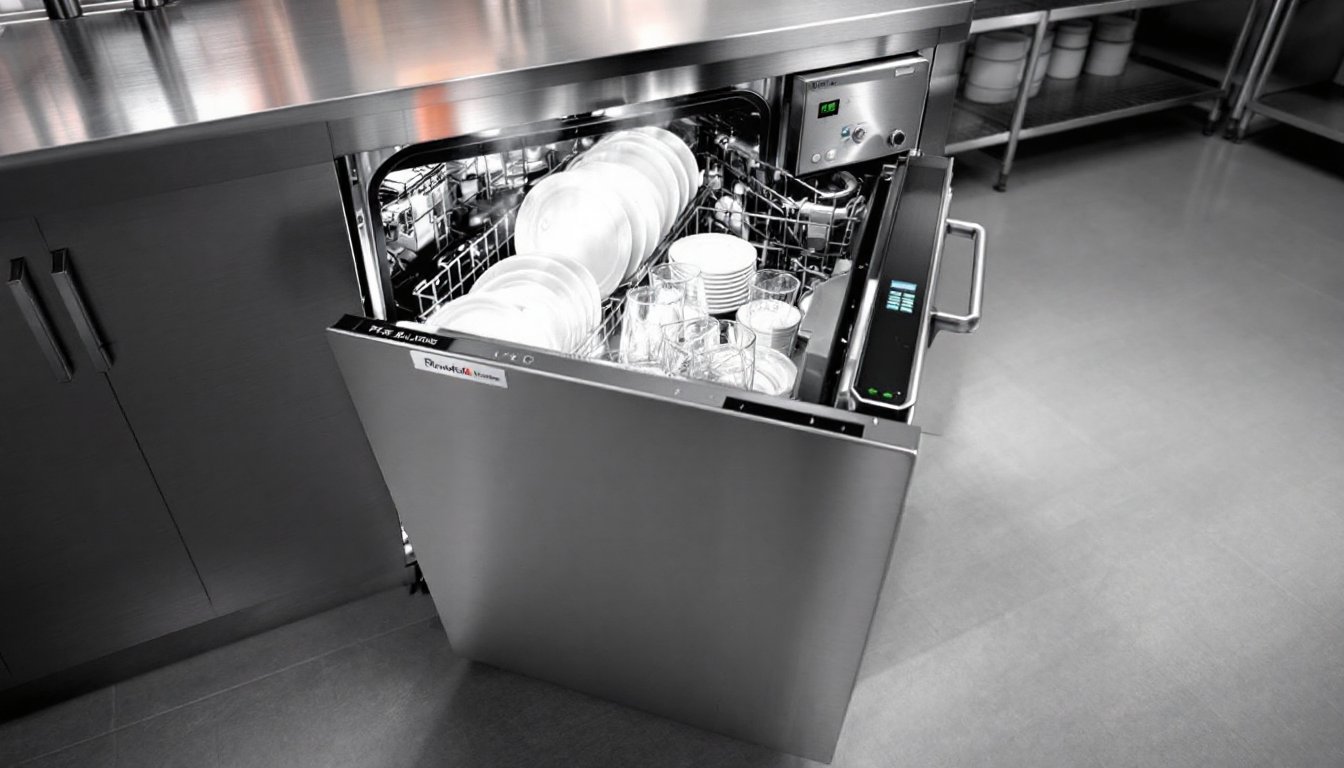
These compact units fit beneath standard 36″–40″ counters and are the go-to for small cafés, bars, and commercial dishwasher for home installations. Under-counter models handle 20–40 racks per hour, each cycle taking 1–3 minutes.
Dimensions and footprint: Most measure 24″W × 24″D × 34″H, similar to a residential dishwasher but built with commercial-grade components. They’re front-loading, so access is easy, and many ship with high-temp or chemical (low-temp) sanitizing options.
Installation requirements:
- Electrical: 208V or 240V, 15–30 amp dedicated circuit. You may need an electrician to add a breaker and run new wire from your panel.
- Water: 3/4″ hot-water supply line, 20+ PSI. A booster heater (built-in or external) may be required to hit 180°F rinse temps.
- Drain: 1.5″ drain connection: check that your existing drain can handle the flow rate (3–5 gallons per minute).
Best for: Home kitchens with heavy entertaining, small restaurants, coffee shops, or assisted-living kitchens. If you’re retrofitting a residential space, confirm your water heater can supply continuous hot water, commercial dishwashers demand more GPM than typical home fixtures.
Door-Type and Conveyor Models
Door-type (or hood-type) dishwashers are upright units where you slide a rack in, lower a hood, and run the cycle. They process 40–80 racks per hour and are common in mid-sized commercial dishwasher for restaurant setups.
Key features:
- Stationary design: The machine stays in place: racks slide in and out.
- High-temp rinse: Built-in booster heaters ensure 180°F+ final rinse.
- Larger footprint: Typically 25″–28″W × 28″–32″D × 60″–80″H. Plan for overhead clearance when the hood lifts.
Installation notes: Most require 208V or 240V three-phase power (common in commercial buildings, rare in homes). If your home has single-phase service, adding three-phase power means a utility upgrade or a phase converter, budget $1,500–$5,000 for the converter alone. Water supply should be 3/4″ or 1″ line with backflow prevention. Drainage needs a 1.5″–2″ air gap or indirect waste connection per local plumbing codes.
Conveyor dishwashers are the workhorses of high-volume operations, think hotel kitchens, large cafeterias, or banquet halls. Dishes ride a belt through wash, rinse, and dry zones: throughput can exceed 200 racks/hour.
Considerations:
- Space: Conveyors span 10–20 feet in length and require loading/unloading zones on either end.
- Utilities: 480V three-phase power, heavy water demand (6–12 GPM), and robust drainage.
- Cost: New units run $10,000–$50,000+. Conveyor models are overkill for most home or small-business applications.
For high-throughput kitchen setups, conveyor models make sense only if you’re processing hundreds of covers per service.
Which type for a restaurant? A small café or food truck typically uses an under-counter unit. A sit-down dishwasher for restaurant with 50–150 seats usually opts for a door-type model. High-volume venues lean on conveyor systems.
Essential Features to Look for When Buying
Sanitizing method comes in two flavors: high-temperature (180°F+ final rinse) and chemical (lower temps with sanitizer injection). High-temp is more common and meets NSF/ANSI Standard 3 for commercial warewashing. Chemical sanitizing uses less energy but requires ongoing sanitizer purchases and monitoring.
Cycle options vary by model. Look for adjustable wash times (light, normal, heavy) if you’ll be cleaning both delicate glassware and heavily soiled pots. Some industrial dishwasher for restaurant units offer express cycles under 60 seconds for glassware during bar rushes.
Rack configuration matters. Standard racks hold plates: peg racks are designed for glasses and stemware. Make sure the unit’s rack size matches your dishware, oversized dinner plates or tall wine glasses may not fit smaller racks.
Booster heater (built-in vs. external): If your water heater can’t sustain 180°F, you’ll need a booster. Built-in boosters add $500–$1,000 to the unit cost but simplify installation. External boosters require additional plumbing and space.
Energy and water efficiency impact operating costs. Look for ENERGY STAR® certification (yes, some commercial models qualify) and check the gallons-per-rack spec, efficient models use 0.7–1.2 gallons per rack versus 1.5+ for older units. When evaluating efficiency benchmarks, remember commercial models prioritize speed over sipping water.
Noise and ventilation: If installing in a home or open kitchen, consider a model with insulated panels. Some units require a Type I or Type II hood for steam exhaust, check local mechanical codes.
Warranty and service: Commercial machines see hard use. A one-year parts-and-labor warranty is standard: extended warranties (3–5 years) cost $200–$600 but can save thousands in repair calls. Verify that local technicians service the brand, obscure imports may lack parts availability.
Installation and Maintenance Requirements
Electrical work almost always requires a licensed electrician. Most commercial dishwashers need a dedicated 208V or 240V circuit: some larger models pull 30–50 amps. If your panel doesn’t have spare capacity, you may need a subpanel or service upgrade, factor $800–$2,500 for electrical modifications. Pull permits as required by your local jurisdiction: unpermitted work can complicate insurance claims and home sales.
Plumbing connections include hot-water supply, drain, and sometimes a separate cold line for chemical sanitizing. Install a backflow preventer or air gap per IRC/IPC codes to prevent contaminated water from siphoning back into the potable supply. Use braided stainless-steel supply lines rated for high temps, and secure the drain with proper venting, improper venting causes slow drainage and odors.
Floor and structural considerations: Commercial dishwashers are heavy (100–300 lb empty) and vibrate during operation. Ensure your floor can support the load, especially if installing on a second story. Concrete or tile over a reinforced subfloor works best: resilient vinyl may telegraph vibrations.
Ventilation and steam management: High-temp units produce significant steam. In a commercial setting, a ventilation hood captures steam and heat. In a residential install, you may get away with good exhaust fans and heat-resistant cabinetry, but check with your building official, some codes require a hood for any appliance generating steam above a certain BTU output.
Daily and weekly maintenance:
- Daily: Scrape and rinse debris from the strainer/screen. Wipe door gaskets. Check wash and rinse arms for clogs.
- Weekly: Remove and clean spray arms, inspect the drain for buildup, and run a deliming cycle if you have hard water.
- Monthly: Descale the booster heater and tank (use manufacturer-recommended delimer). Inspect hoses and connections for leaks.
Safety gear: Wear heat-resistant gloves and safety glasses when servicing, tanks and rinse water exceed 180°F. Turn off power at the breaker before accessing electrical components.
Hard-water management: If your water hardness exceeds 7 grains per gallon, install a water softener or use a deliming agent regularly. Scale buildup reduces efficiency and can void warranties.
Professional servicing: Schedule annual inspections by a certified technician. They’ll check thermostats, pressure switches, and sanitizer dispensers (if chemical system). Budget $150–$300 per service call: catching small issues early prevents costly breakdowns mid-shift.
If you’re considering a commercial dishwasher for home use, weigh installation complexity and operating costs against the convenience of rapid cycles and high capacity. For many DIYers, a high-end residential model with a sanitize cycle and third rack offers a middle ground, check your priorities and don’t overbuild if you don’t need true commercial throughput.