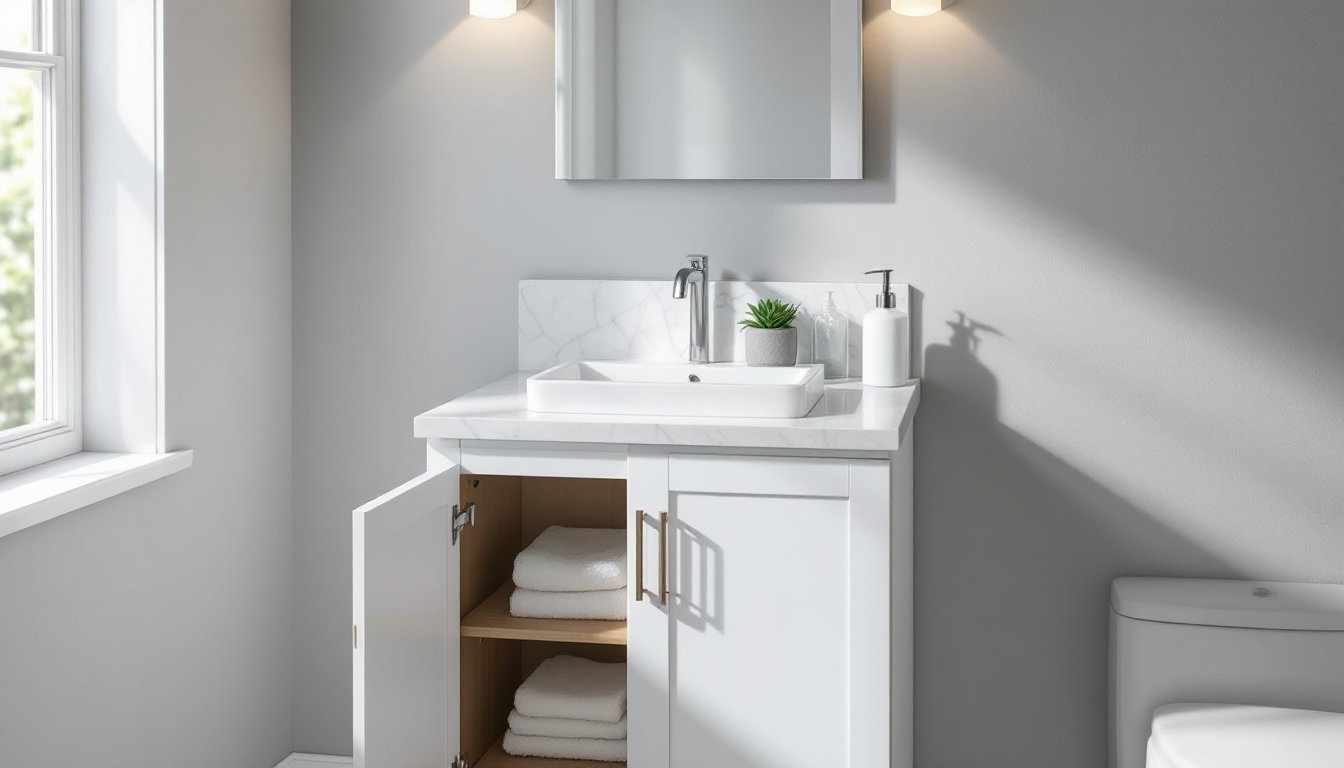
Bathroom space comes at a premium, especially in older homes, powder rooms, or condos where every square foot counts. A 31 inch bathroom vanity strikes the sweet spot between functionality and footprint, wide enough to include meaningful storage and counter space, but compact enough to fit where standard 36-inch vanities won’t. Unlike cramped pedestal sinks or undersized 24-inch units, a 31-inch vanity gives homeowners room to work without dominating the floor plan. Whether tackling a full renovation or a quick cosmetic refresh, understanding what separates a well-designed compact vanity from a flimsy compromise makes all the difference.
Table of Contents
ToggleKey Takeaways
- A 31 inch bathroom vanity provides the ideal balance between storage and footprint, fitting spaces where standard 36-inch vanities won’t while offering significantly more functionality than cramped 24-inch alternatives.
- Choose plywood or solid wood cabinet construction with soft-close hinges and quality drawer glides to ensure durability in humid bathroom environments; avoid particleboard and stapled corners that fail under weight.
- Select countertop and sink materials strategically: cultured marble for seamless integration, granite or quartz for durability, and single-bowl undermount sinks for maximum counter space and ease of cleaning.
- Match your 31 inch vanity finish and hardware to your bathroom’s existing style—whether traditional, modern, farmhouse, or coastal—using wall color and lighting to visually expand the space.
- Proper installation requires accurate measurement of supply lines and drain locations, anchoring into studs, and careful leveling; most DIY installs take 4–6 hours but pay off with professional results.
Why a 31 Inch Vanity Is the Ideal Choice for Smaller Bathrooms
Standard bathroom vanities typically come in 24, 30, 36, 48, and 60-inch widths. The 31-inch size sits in a less common but highly practical niche, it’s just wide enough to accommodate a functional countertop and a single undermount or vessel sink, while leaving clearance for door swings and foot traffic.
In powder rooms and half baths, where the International Residential Code (IRC) requires only 21 inches of clear space in front of fixtures, a 31-inch vanity allows for a proper hand-washing station without crowding the toilet or encroaching on the doorway. For full baths in older homes, where room dimensions were often irregular, this size adapts to spaces that measure between 5 and 6 feet wide without requiring wall modifications.
Another advantage: a 31-inch vanity typically includes two cabinet doors or a single-door-plus-drawer configuration, which beats the single-door limitation of most 24-inch models. That extra 7 inches of width translates to usable storage for toiletries, cleaning supplies, or spare towels. Homeowners retrofitting a pedestal sink will find the added storage especially valuable, as most home improvement projects benefit from increased functionality without major layout changes.
Cost is another factor. Because 31-inch vanities are less mass-produced than 36-inch units, expect to pay $300–$900 for a solid wood or plywood cabinet with a stone or engineered countertop, depending on finish quality and hardware. That’s roughly 10–15% more than a comparable 30-inch model, but the payoff in storage and counter space is proportional.
Key Features to Look for in a 31 Inch Bathroom Vanity
Not all 31-inch vanities are built the same. Cabinet construction, drawer glides, and countertop material dictate both longevity and daily usability.
Storage Options and Cabinet Configurations
Cabinet construction matters more than finish. Look for plywood or solid wood boxes, not particleboard or MDF, especially in bathrooms with high humidity. Check for dovetail or dowel joints in drawer boxes: stapled corners fail quickly under the weight of hair dryers and product bottles.
Common configurations include:
- Two-door cabinet with a single adjustable shelf (simplest, most affordable)
- One-door, one-drawer setup (drawer holds small items: cabinet stores taller bottles)
- Two-drawer stack above a single-door cabinet (maximizes organization: costs 15–20% more)
Soft-close hinges and drawer glides aren’t luxury features, they’re insurance against slammed doors and misaligned cabinets over time. Blum or Hettich hardware adds about $40–$60 to the unit cost but pays off in durability.
If the vanity lacks a backsplash, plan to add one or caulk the seam between countertop and wall. A 4-inch marble or quartz backsplash costs about $30–$50 and prevents water from wicking into drywall.
Countertop and Sink Styles That Maximize Space
The countertop on a 31-inch vanity typically measures 31 x 22 inches, though some models go narrower (19 inches deep) to save floor space. Material choices include:
- Cultured marble (integrated sink and counter: one-piece, no seams: $150–$250)
- Granite or quartz (durable, heat-resistant: undermount sink required: $250–$450)
- Porcelain tile (budget-friendly but grout lines trap moisture: $80–$150)
For sink styles, prioritize function over aesthetics:
- Undermount sinks (easy to wipe debris into sink: requires stone or solid-surface counter)
- Drop-in/self-rimming sinks (simplest install: works with any countertop material)
- Vessel sinks (adds 5–7 inches of height: requires taller faucet and reduces usable counter space)
A single-bowl rectangular sink in white vitreous china is the most versatile choice, it pairs with any style, drains efficiently, and costs $40–$80 to replace if damaged. Avoid oversized decorative bowls that leave less than 3 inches of counter on either side: that’s barely enough room for a soap dispenser.
Faucet clearance is critical. Measure from the back edge of the countertop to the center of the drain. Most 31-inch vanities use a 4-inch centerset faucet or a single-hole faucet with a 6- to 8-inch spout reach. If the sink is offset, check that the faucet won’t spray against the backsplash or sidewall.
Popular Design Styles for 31 Inch Vanities
A 31-inch vanity can anchor almost any design palette, from farmhouse to minimalist modern. Match the cabinet finish and hardware to existing trim and fixtures for a cohesive look.
Traditional/Transitional: Raised-panel doors, oil-rubbed bronze or brushed nickel hardware, and a white or cream finish. Pair with a white Carrara marble countertop and a chrome or brushed-nickel faucet. This style works in older homes and blends well with wainscoting or crown molding. Many interior design resources showcase classic vanity pairings with marble and vintage-inspired hardware.
Modern/Contemporary: Flat-panel (slab) doors, matte black or stainless steel pulls, and finishes in gray, navy, or espresso. Choose a quartz or solid-surface countertop in white or concrete-look gray. Wall-mounted faucets and frameless mirrors complete the look. This style requires clean lines, skip ornate backsplashes and stick to simple geometric tile.
Farmhouse/Rustic: Natural wood or distressed painted finishes (white, sage green, weathered gray), with visible wood grain and simple knobs or bin pulls in aged brass or black iron. A vessel sink in hammered copper or a white apron-front style reinforces the aesthetic. Open shelving below (instead of doors) adds farmhouse charm but sacrifices concealed storage.
Coastal/Spa: Soft blues, whites, or driftwood-toned finishes with brushed gold or polished chrome hardware. Pair with a white quartz countertop and a rectangular undermount sink. Add a frameless mirror and matte white subway tile for a clean, beachy vibe.
When selecting a finish, consider bathroom lighting and wall color. Dark vanities (navy, charcoal, espresso) add drama but can make small bathrooms feel cramped unless balanced with bright walls and good overhead lighting. Light finishes reflect more light and visually expand tight spaces.
Installation Tips and Measurements for Your 31 Inch Vanity
Installing a 31-inch vanity is a manageable DIY project for anyone comfortable with basic plumbing and carpentry. Most installs take 4–6 hours including removing the old vanity, but plan for a full day if you’re also replacing the faucet or upgrading supply lines.
Pre-Installation Checklist:
- Confirm rough-in dimensions: Measure existing supply line and drain locations. Standard supply lines are 21 inches above finished floor: drains center at 16–20 inches.
- Check wall studs: Use a stud finder to locate framing. Vanities should anchor into at least two studs. If studs don’t align, install a horizontal cleat (1×4 or 2×4) between studs at the vanity’s mounting height.
- Inspect the subfloor and wall: Look for water damage, soft spots, or mold. Replace damaged drywall or underlayment before installing the new vanity.
- Turn off water at the shut-off valves (or main if valves are seized).
Step-by-Step Installation:
- Remove the old vanity: Disconnect supply lines and P-trap. Cut caulk seams with a utility knife. Unscrew mounting brackets or screws, then lift the vanity off the wall. If the countertop is separate, remove it first.
- Dry-fit the new vanity: Slide it into position and check for level (front-to-back and side-to-side). Use shims under the base or behind the back to correct minor dips or humps. Don’t force it, walls and floors are rarely perfectly square.
- Mark mounting holes: Most vanities have a hanging rail or cleat on the back. Mark screw locations through the mounting holes, then pull the vanity away.
- Drill pilot holes and anchor: Drill into studs using 3-inch wood screws (#10 or #12). If mounting between studs, use toggle bolts rated for at least 50 lbs each. Drywall anchors alone won’t hold.
- Reposition and secure: Lift the vanity onto the screws, check level again, and tighten. Leave a 1/8-inch gap between the vanity back and wall to accommodate baseboards or uneven surfaces.
- Attach the countertop: Some tops rest on the cabinet and are held by weight and caulk: others screw up through corner brackets inside the cabinet. Follow manufacturer instructions. Run a bead of clear silicone caulk along the back edge where the countertop meets the wall.
- Install the faucet and drain: It’s easier to install the faucet and pop-up drain assembly before setting the countertop, especially with undermount sinks. Use plumber’s putty or a rubber gasket under the drain flange. Hand-tighten the locknut, then snug it with pliers, overtightening cracks porcelain.
- Connect supply lines and P-trap: Use braided stainless steel supply lines (they’re more reliable than plastic). Wrap threads with Teflon tape (three wraps clockwise). Tighten by hand, then give it a quarter-turn with a wrench. Connect the P-trap, ensuring the trap arm slopes slightly toward the wall drain (1/4 inch per foot).
- Test for leaks: Turn on the water and let it run for 2–3 minutes. Check all connections, supply lines, drain tailpiece, and P-trap joints. Tighten as needed.
- Caulk the base: Run a bead of latex or silicone caulk where the vanity meets the floor and along the backsplash seam. Smooth with a wet finger or caulk tool.
Tools you’ll need:
- Adjustable wrench and basin wrench (for tight faucet nuts)
- Drill/driver and bits (including a 1/8-inch bit for pilot holes)
- Level (24-inch or longer)
- Utility knife and caulk gun
- Bucket and towels (for draining trap)
Safety notes: Wear safety glasses when drilling overhead or into tile. Use a dust mask if cutting through old drywall (possible lead paint or asbestos in homes built before 1980). If you encounter galvanized or lead supply pipes, consider hiring a plumber to replace them, old pipes can crack during removal.
Permit requirements: Most jurisdictions don’t require a permit for vanity replacement if you’re not moving plumbing or electrical. If you’re relocating the drain or adding new outlets, check local codes, many areas require a licensed plumber or electrician for those changes.
Conclusion
A 31 inch bathroom vanity solves real-world space constraints without sacrificing the storage and counter area that make a bathroom functional. By focusing on solid construction, smart storage configurations, and finish details that match the room’s style, homeowners can find a compact vanity that punches above its size class. Measure carefully, anchor properly, and don’t skip the prep work, most installation headaches stem from rushed measurements or skipped level checks. With the right unit and a methodical approach, a 31-inch vanity transforms a cramped bathroom into a space that actually works.